Art is Communication : Exchanging History, Culture, and Learning at the Former Nishijin Weaving Factory
The Japanese version of this Article can be read from here!
”*** in Residence Kyoto" is a residency program where creators coming from abroad and Kyoto residents share their daily lives and learn from each other, fostering new values and relationships.
This time, we closely followed Masahiko Takeda, an artist and owner of the residence, and Paul Bonneville, an artist and fashion designer from France, who are based in his family's Former Nishijin Weaving Factory in Kyoto. Reverberations from the factory, a small coffee shop in the town, conversations in the living room --What came into view throughout the day was the learning and questioning behind the production process, and the moments when their backgrounds intersected with each other.
The residency is not only a "place to stay" and "place to create artworks," but also a place where people meet, talk, and nurture future relationships.
On the last day of the residency, Youth Coordinators Towa Shinden and Kazuki Yamamoto spent a day with the participants to trace their memories of their stay
The text is interspersed with comments (YC Notes) by Youth Coordinators who were not in charge of writing the book. We hope you will enjoy the multilayered reading experience, as if you are gently being interrupted with a surprise or insight from another perspective each time you turn the page.
- Interviewer & Article Writer / Youth Coordinator
INDEX
CreatorResidence2025/10/5 Weather:⛅️
11:00 at Former Nishijin Weaving FactoryA New Approach That Fully Embraces the Material and Its Regional Context “I like the sound of the factory" - a place where sound evokes memories13:00 at Hive CoffeeIs One Month Too Short for a Residency in a City Where “Kyoto Time” Flows?Connections Shaped by Space : How the Work and the Venue Became the Center of CommunityAiming to Create in Kyoto AgainThe Starting Point
— Exploring the origins of the creators and owners15:00 at Living Room
— A Space of Many Questions: A Residency Where People Influence One AnotherBeyond Expectations: Encounters That Became the Axis of the Work“Creative Residency” as the Key to Unlocking Possibilities
— The Chemistry Between Owner and CreatorEmbracing “change” - Energy Born from Different PerspectivesThe Best Moment of the Creator and the Residence Owner!17:00 Farewell Party at CORNER MIX
“Farewell Is Not the End, but the Beginning of a Relationship”
— The Open Space a Residence Leaves for What Comes NextIn Closing
— Not a Farewell, but the Beginning of a Dialogue
2025/10/5 Weather:⛅️ 11:00 at Former Nishijin Weaving Factory
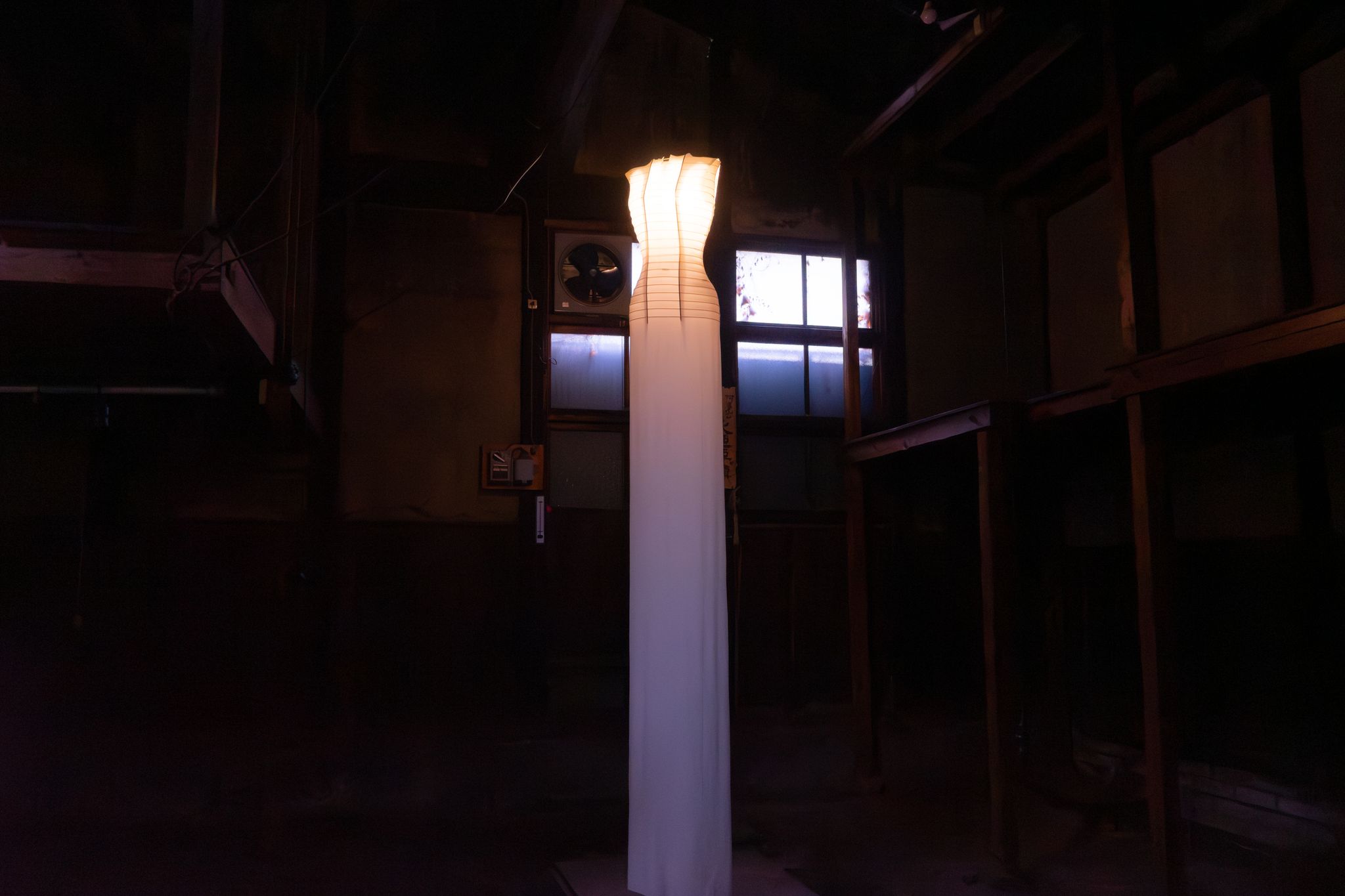
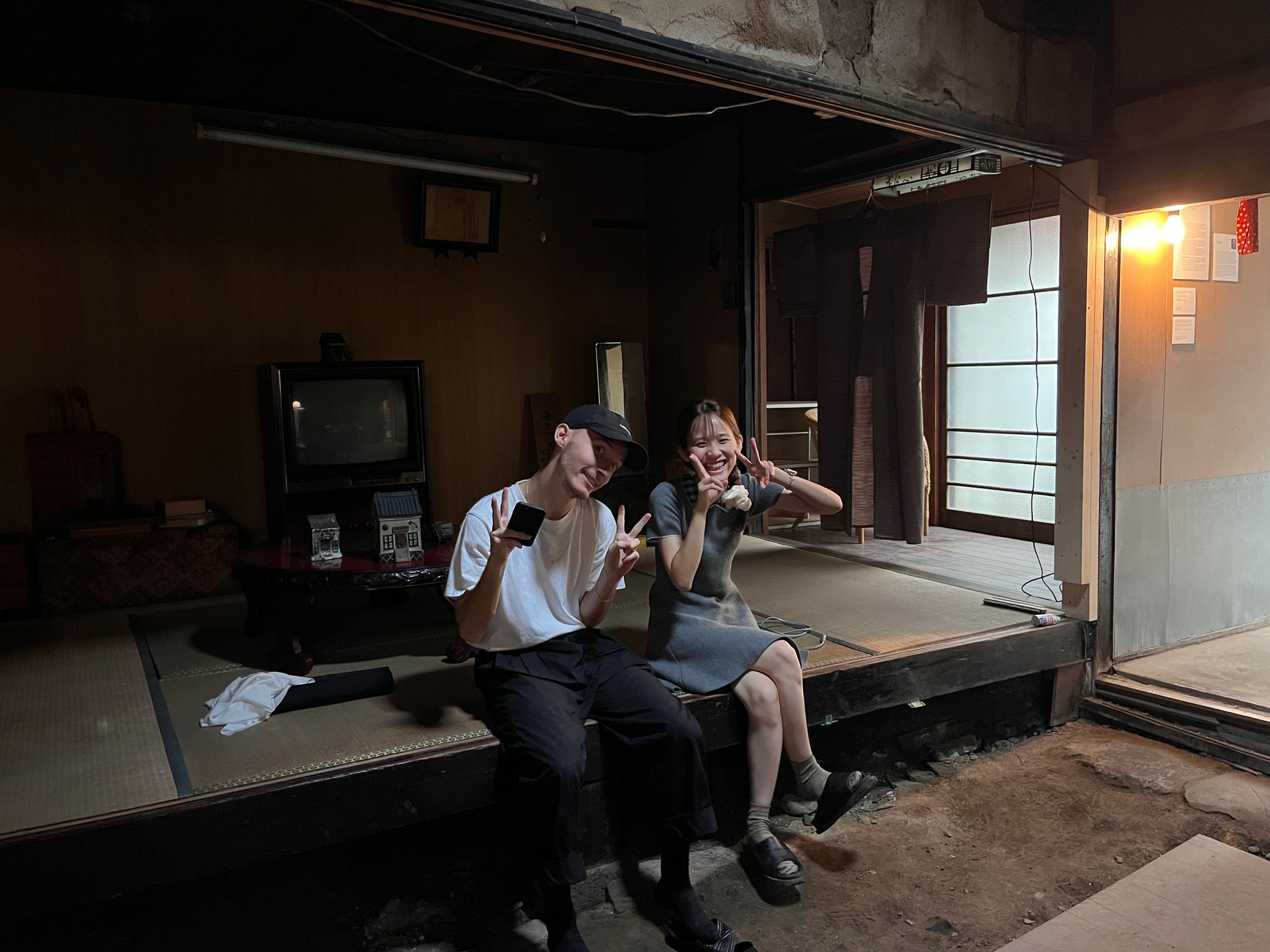
Photographing the works during the deinstallation process.
A New Approach That Fully Embraces the Material and Its Regional Context
Towa
Once again, a wonderful piece of work. How did you go about creating it?
Paul
In the first week, I shared ideas with Masahiko. I realized that there was a lot of overlap between the bottoms I had made in the past using elasticity of fabrics and the characteristics of "Tango Chirimen," which is closely related to Nishijin Weaving, as explained by Masahiko. This led me to do research on Tango Chirimen.
We visited Marusen Corporation in Tango, where we were given a factory tour and an introduction to Tango Chirimen. Tango Chirimen is a silk fabric woven flat and then dipped in boiling water to shrink the fabric, which is then spread out to create a unique uneven texture.
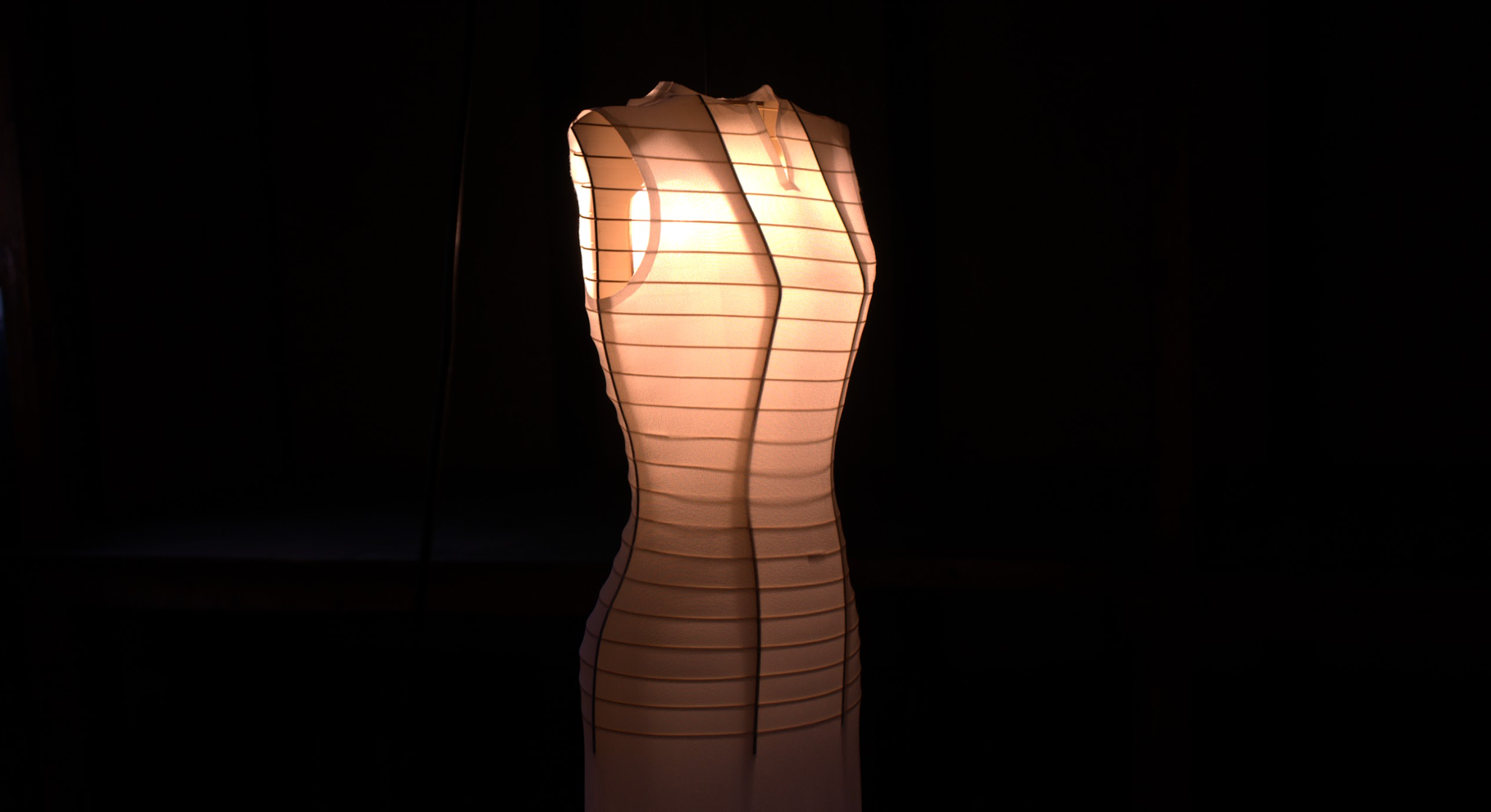
Inspired by the streets of Kyoto, I was thinking of making a long dress like an "eel's nest," but when it came to making the waist part of the dress, I had to cut the fabric. I always want to take advantage of the characteristics of the material itself, so I try to avoid cutting and sewing the fabric as much as possible, as I do with kimonos.
When I asked about the shrinking process of Tango Chirimen, I asked Mr. Marusen, "Is it possible to leave only a part of the fabric shrunk?". He replied, "We might be able to do that. Let's give it a try!” and he immediately experimented at the factory. The experiment was a great success, and by leaving the shrinkage only at the waist, we were able to complete the dress with a single piece of Tango Chirimen without cutting the fabric.
Masahiko
When Mr. Marusen visited the exhibition, I was deeply moved to hear him say, “I was truly delighted that you turned the shrinking property, often seen as a weakness of Tango Chirimen, into something so beautiful.”
Paul
By making clothes out of a single piece of fabric, you can transform it into many different things. Using the transparency of Tango Chirimen, I was also able to realize the idea of using it as a lantern/lighting. Making the torso for the bamboo lot was actually the most difficult part.
YC Notes | Towa
It’s amazing how you bring out the best in the fabric so efficiently. The idea of making use of Tango Chirimen’s shrinking characteristic emerged from Paul’s experiments with Mr.Marusen, during which he tried tying the fabric and pouring hot water over it. It is fascinating that the article also reveals the process through which the idea gradually took shape.
“I like the sound of the factory" - a place where sound evokes memories
Towa
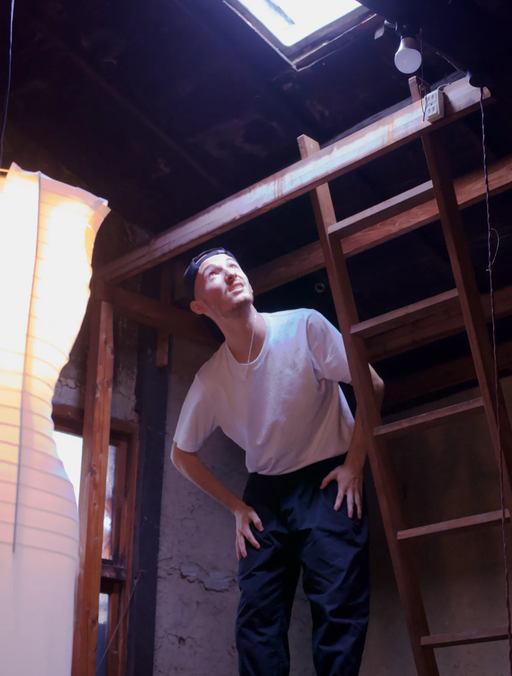
The lighting on the long dress suits this space beautifully. It feels very calming. And the sound of the factory is wonderful too. The rhythm of the looms is so soothing.
Paul
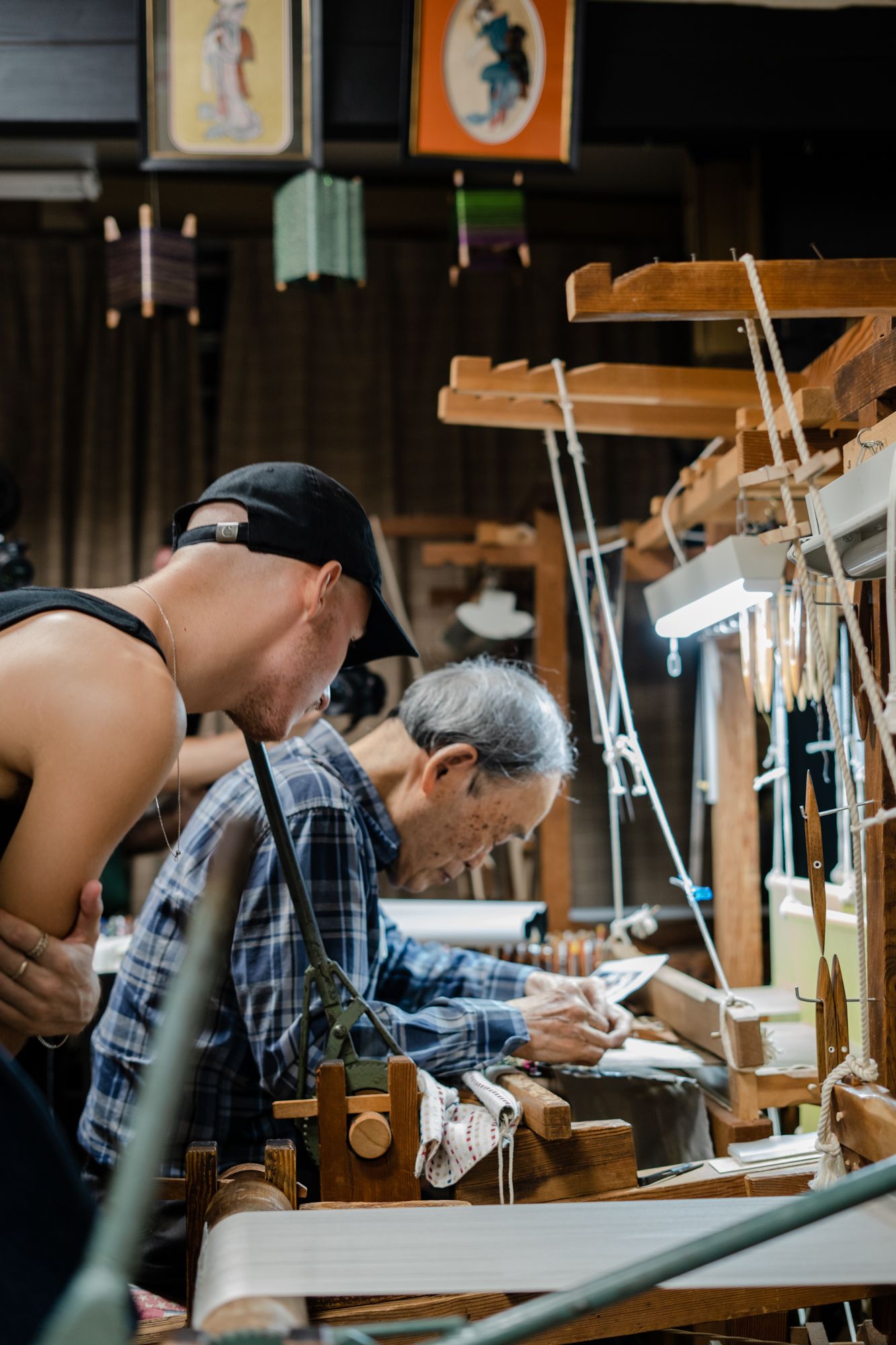
I really love the sound of the factory as well. It isn’t the live sound, actually we’re playing a recording. Masahiko recorded it at a Tango Chirimen textile factory and is playing it back here. The idea of incorporating sound came from him, he’s a musician, after all.
Masahiko
My grandparents’ generation used to weave Nishijin Weaving in this factory, but it was closed about thirty years ago and hasn’t been used since. When I was a child, I was afraid to go inside, so I don’t really remember what it looked like. What stayed with me, though, was the sound of the factory. Even outside the house, there were many weaving factory in the neighborhood when I was young, and this sound could be heard everywhere.
Towa
So the sound of the loom is what remains in your memory. When you listen carefully inside the factory, you can also hear sounds from outside—the way different sounds blend together is fascinating.
Paul
You can even hear the neighbors. I think the closeness of the neighboring houses feels very Kyoto-like.
YC Notes | Towa
Because we were in the middle of work, the conversation did not flow at great length. However, what I sensed through our exchange was Paul’s determination to absorb every possible experience and sensation into his work. Of course, the piece itself is grounded in meticulous research, but I was once again struck by how attentively he listens—to conversations with Mr. Takeda and others he encountered, and, as mentioned earlier, even to “sound.” It seems to me that it was precisely because of Paul’s openness in this way that having Mr. Takeda, a musician, serve as the residence owner became such a positive influence on the project.
13:00 at Hive Coffee
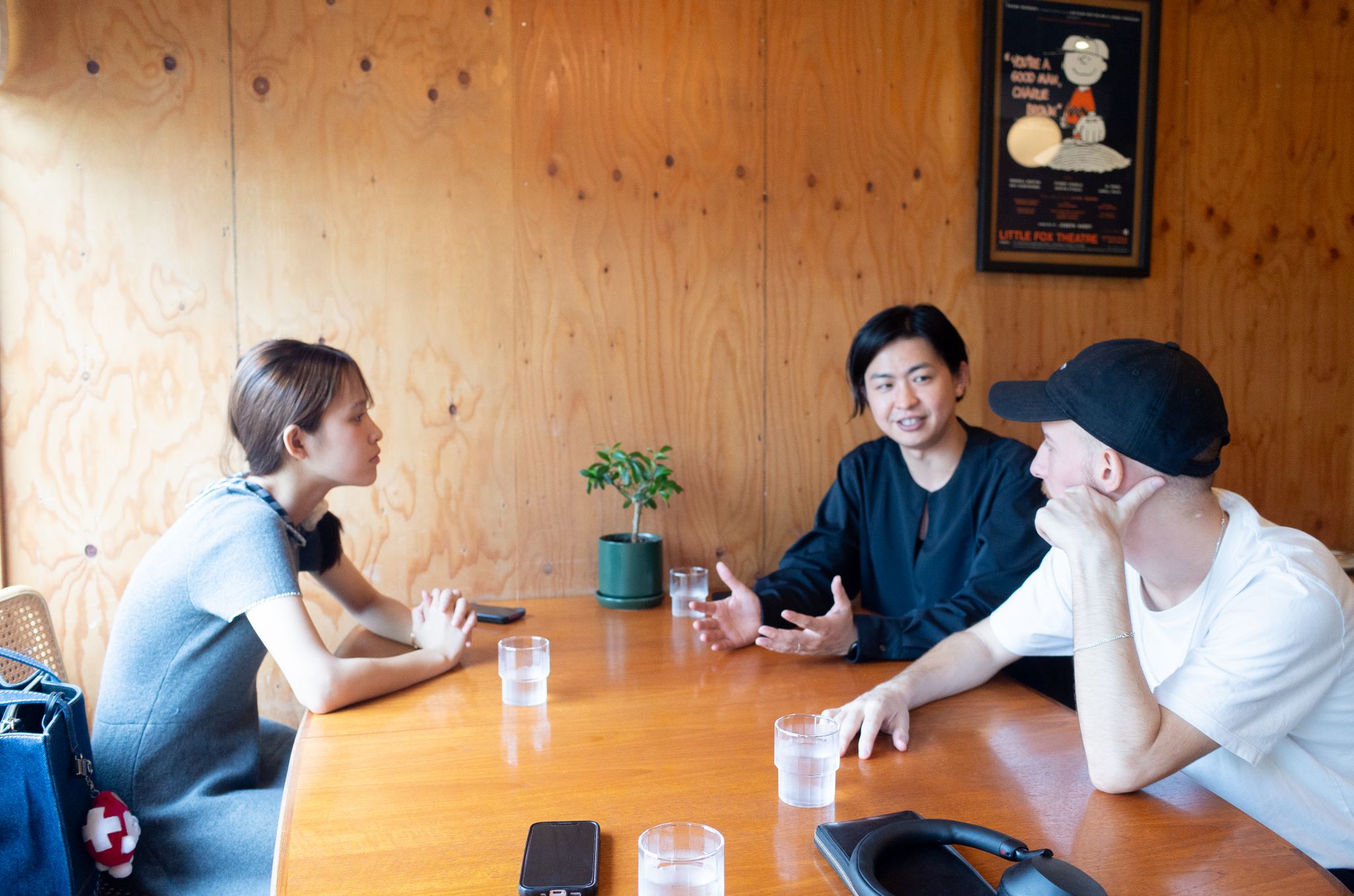
Lunch at a nearby cafe after the works removal
Is One Month Too Short for a Residency in a City Where “Kyoto Time” Flows?
Towa
May I ask again how you feel about participating in *** in Residence Kyoto ?
Paul
It was exactly as I had imagined, an incredible project. I’m very satisfied with the balance between creative time and moments of relaxation.
The only real challenge was that the residency felt too short. In the final two weeks, as I began producing the work in earnest for Nuit Blanche and preparing the exhibition, everything became such a blur that I can hardly remember it. But the first two weeks were truly wonderful. They became a period of thinking deeply about how to bring my ideas into reality.
YC Notes | Hana
As I thought, Paul felt like your stay wasn't long enough.
Towa
That's right. We had a lot of social events to work with the community.
Paul
Yes, but on the other hand, social events were very important. For me, the social part was the most important, as I am thinking of coming back to Kyoto after this event. I felt that making connections was more important than the creative process. This is a unique feature of *** in Residence Kyoto.
However, what was difficult this time was that I had to submit something since my stay was based on the premise of presenting my work at "Nuit Blanche Kyoto". Generally, in residency programs like this, we are not asked to submit anything in terms of results or output. This is because for us creators, the most important thing is to connect with people and communicate with them.
Towa
That’s true. Having a presentation at Nuit Blanche built into the residency must make for a demanding schedule for creators.
Paul
Yes, it does. But more than anything, the human connections were truly wonderful. I had the chance to meet so many people, and the experience of meeting and building relationships with those who live here was incredibly valuable. In this one month, I spoke with more people than I had in the previous 22 years of my life! Everyone I met was fascinating and inspiring.
By participating in *** in Residence Kyoto, I feel I was able to meet far more people than if I had simply come to stay for Nuit Blanche alone. Coming to Japan and actually meeting people and forming real connections is not easy. But *** in Residence Kyoto really served as a bridge.
As for the question of time, it may also have something to do with Kyoto itself. In Kyoto, it is important to take time and proceed carefully. In France, for example, you can usually find a quick and efficient way to get things done. If you go to a certain person, they will take care of it. But here, you are first introduced through someone, then you pay a visit and greet them in person, then you present your project, and only after that does it move forward. It naturally takes more time. So perhaps one month is indeed a little short for a residency here.
Connections Shaped by Space : How the Work and the Venue Became the Center of Community
Towa
What did you think of the exhibition at the Former Nishijin Weaving Factory?
Paul
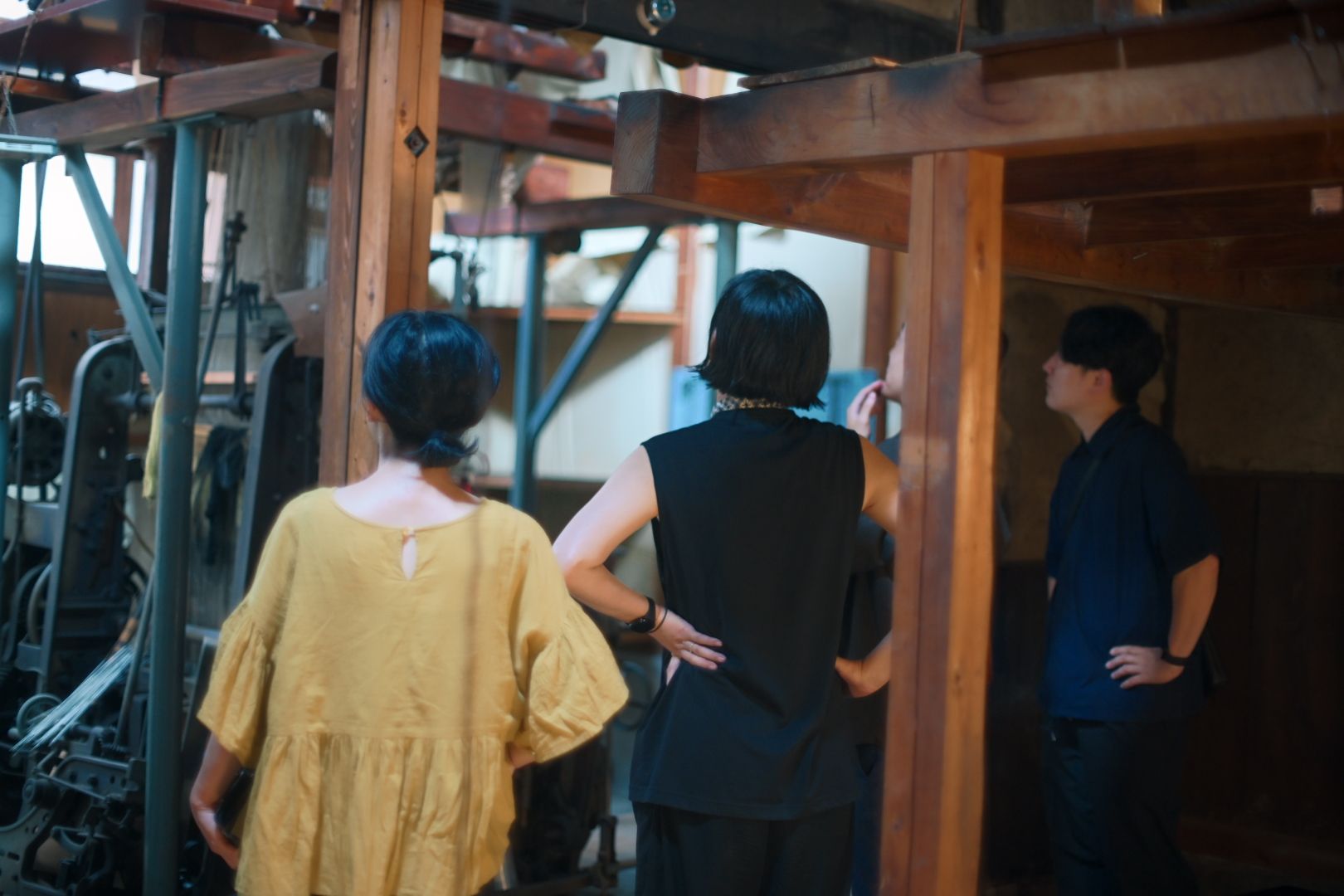
It was really nice to have people come. It is also good not only to present the work, but also to use the work as a starting point for discussion. The exhibition was held in a very special place, the Former Nishijin Weaving Factory, so I was able to talk about my work from an artistic point of view, and Masahiko was able to talk about the history of the area through the Former Nishijin Weaving Factory.
Masahiko
Through Paul’s residency and exhibition, I was able to connect with members of the local community whom I had never interacted with before, including active Nishijin weaving factory nearby, Doshisha University, and the Kamigyo Ward Office. I have lived here for a long time myself, but I realized how much I still did not know about the current state of Nishijin Weaving and the history of this area. It was truly an eye-opening experience.
I have heard that Doshisha University and other universities are also thinking about how to build stronger connections with the local community. There is potential for new initiatives, such as small neighborhood tours and interview-based research projects. By collaborating with universities, it may become possible to collect and preserve the memories of the area.
Paul
Collaborating with students sounds very inspiring. They all have such interesting ideas, and I think it would be incredibly stimulating.
YC Notes | Towa
What left a strong impression on me was how repeatedly he spoke about the value of communication that emerges through the work itself. He responded carefully to questions about the concept and intentions behind the piece, and it was fascinating to feel my understanding of the work sharpen and deepen through the very act of conversation.
Aiming to Create in Kyoto Again
Towa
What are your plans for the future?
Paul
My next project is to come back to Kyoto. I met so many people in Kyoto this time, and I think that lowered the bar for my next project. This is thanks to *** in Residence Kyoto. It is really difficult to start a new project in a new place, not only to find money and a place, but also to find people who are interested in me. Especially as a foreigner, it is really difficult to make connections and start something in Japan. But thanks to *** in Residence Kyoto, I was able to meet people who are interested and involved in my efforts.
Towa
So, this project has connected you with people and has had a positive impact on your future works.
Paul
Yes, it has. Moreover, I felt that Kyoto was a better place than Tokyo to connect with people in this way. I feel it is much easier to meet people in Kyoto. This surprised me. Because I had always heard that 'people in Kyoto don't want to talk to foreigners. Everyone I met was very kind and welcoming.
Towa
Perhaps Kyoto is more based on a community of "connections" and "relationships”. A creator who came from India last year said, "Kyoto is like a big village.”
Paul
That is exactly how I felt as well. How many people came to the exhibition, and whether it was able to lead to the next step. The people I worked with during the production process, and those they in turn introduced me to… It really felt like a “big village.” A sense that everyone is closely connected within this large village.
When I think about my future career, one challenge is that I would like to open a shop and start my own business. I had been considering doing that in Tokyo, but given my age and financial situation, I feel it would be difficult to run something in a major city like Tokyo right now. That is precisely why I feel drawn to Kyoto as the next step. During my stay, I noticed how many small shops are scattered across different neighborhoods here. Not all of them are crowded, but around ten people come by steadily each day, showing interest in the products or exhibitions. I feel that in Kyoto, it is possible to find a space that is large enough to present my work. There is a way of life here where people casually drop into neighborhood shops, and I find that very appealing.
From an industrial perspective, it is extremely difficult today to cross the boundary between large corporations and independent businesses. In the fashion industry in particular, major companies hold tremendous power.
Towa
In that kind of situation, how do you plan to carve out your own path?
Paul
I think the best approach is to find a way that exists outside the conventions of the current fashion industry and to remain small. To stay small and continue creating. In that sense, Kyoto might be the ideal place. Fashion is a crazy world. But for me, having a small shop, making a living, and selling just enough clothing to continue creating new pieces would be perfect. I do not need anything more than that.
C’est la vie! That’s life.
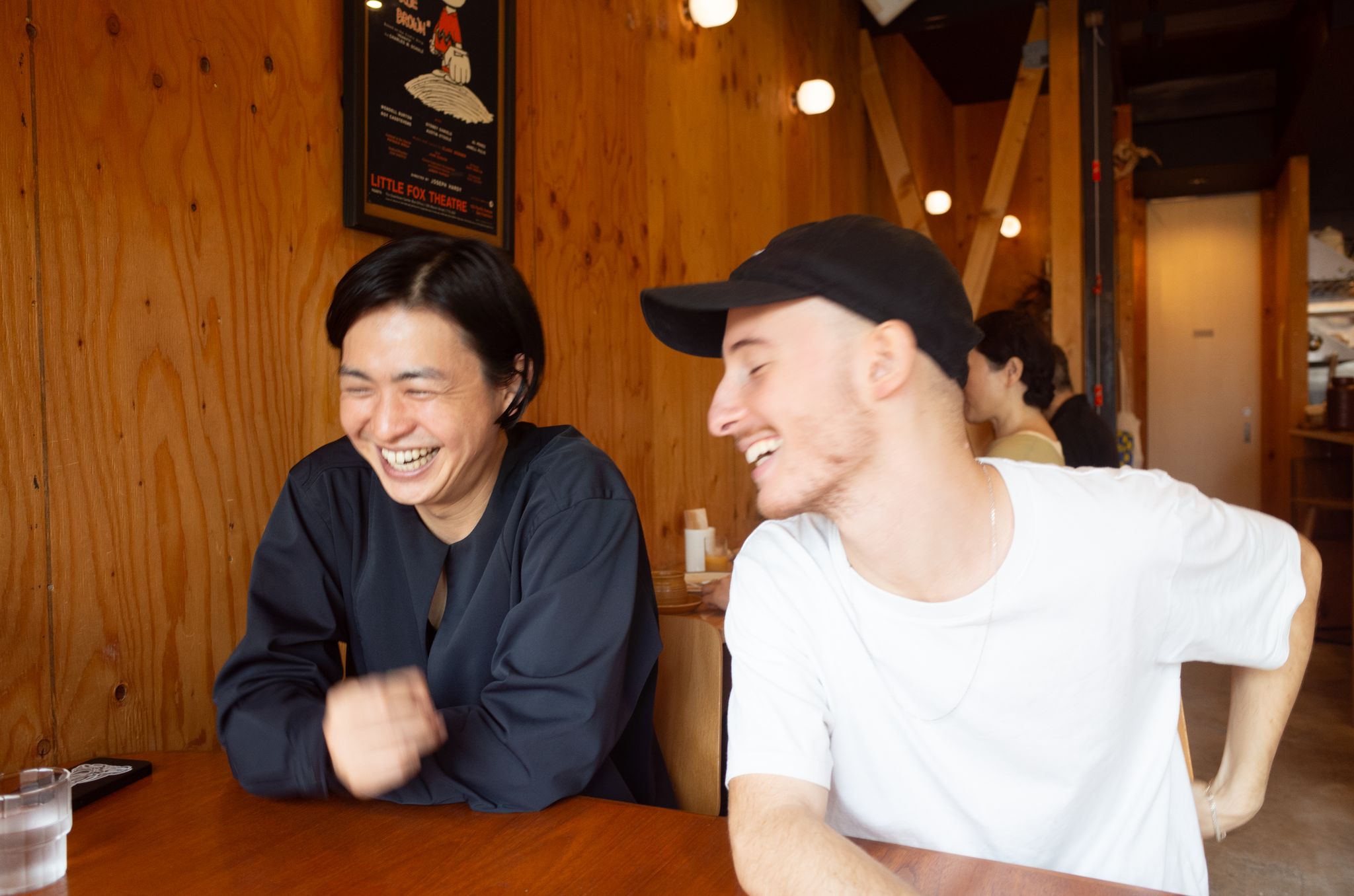
The Starting Point — Exploring the origins of the creators and owners
Towa
What first led you to start studying art?
Paul
After graduating from high school, I attended a preparatory school to enter art school. At that time, I was working on sculpture and painting, something completely different from fashion. Later, I entered 「ENSAD ( Ecole Nationale Supérieure des Arts Décoratifs ) 」, the French National Studio of Contemporary Arts. It was there that I first became interested in fashion as a means of expression. I was also deeply moved by Yohji Yamamoto’s film “Notebook on Cities and Clothes”. That experience led me to pursue fashion.
Towa
So fashion wasn’t your starting point!
Paul
No, not at all. Even when I began studying fashion design, I was creating very conceptual pieces. After that, I moved to Japan to study at Bunka Fashion College, and later I worked under Yohji Yamamoto. At Yohji Yamamoto, I learned how to make truly good clothes. Since then, my thinking has changed, and I have gained a different perspective.
Towa
What kind of perspective do you value now?
Paul
I often say that I want to build my own brand, but in reality I am not thinking only about fashion. I am interested in anything that can become a designed object. I believe that good expression emerges when different elements are brought together and a new “bridge” is found between them.
Kyoto is such a wonderful place to create because there are so many crafts here that can be applied in different ways. This environment naturally generates new ideas. For a creative life, coming here is like discovering a gold mine. Simply watching people make things is enough to inspire me enormously.
Towa
So something new is born when different elements come together. I would love to hear more about that.
Paul
Concepts are born when people ask, “Why do you make this work?” or “Why do you think this way?” When, in my mind, my own images connect with ideas from other fields, that connection can become a creative identity.
For example, Masahiko, the residence owner, works with the ideas of “sounds” and “Nishijin weaving.” When you hold these two distinct fields and search for something in between them, that is where a truly unique and original idea can emerge.
Masahiko
At first, I never imagined crossing the fields of “sounds” and “Nishijin Weaving.” But as Paul says, once I began connecting the two in my work, new forms of expression emerged. At the same time, it opened up new relationships with the local community and with people from different disciplines.
YC Notes | Kazuki
I was struck by how he crosses different disciplines before finally returning to fashion. Perhaps that is why his work cannot be confined to the label of fashion—it holds a depth that extends far beyond it.
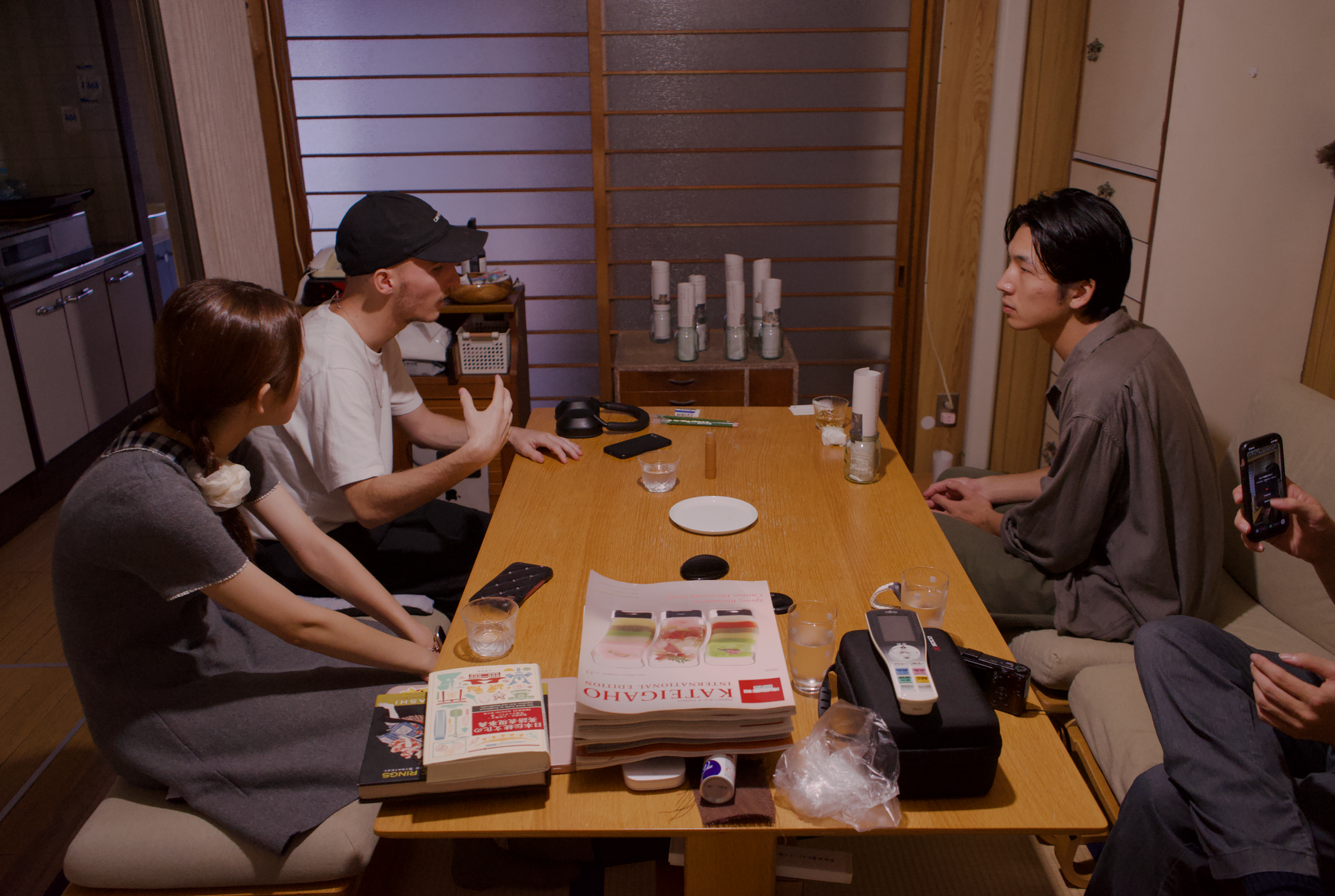
15:00 at Living Room — A Space of Many Questions: A Residency Where People Influence One Another
Beyond Expectations: Encounters That Became the Axis of the Work
Towa
May I ask what first led you to participate in this project?
Paul
I had visited Japan as a child and had always wanted to return. While I was looking for an opportunity, I received information about Nuit Blanche Kyoto. I also had the desire to launch my own brand in Japan, so I felt that the timing was right. Then I saw the presentation for *** in Residence Kyoto and Masahiko’s proposal, and I thought, “There’s no reason not to apply.”
Towa
After actually taking part, did your impression change?
Paul
It exceeded my expectations. I had read an article about the French creator who participated last year, so I assumed there would be many encounters and meetings. But the timing was even better than I had imagined, and I met incredible people. For such a short period, I felt I could not have asked for more.
Towa
Because your work is rooted in encounters with people and materials in Kyoto, I imagine this experience must have been especially significant. Masahiko, how did you feel?
Masahiko
For me as well, it was beyond expectations. My background is in music, but I am perhaps more interested in craftsmanship and culture than in art per se. That is precisely why I was drawn to the way his project unfolded—how the work gradually took shape while engaging with the cultural and craft contexts of the region where he was staying.
Many artists begin with their inner emotions or impulses. Paul, however, began with the history of the region, the materials, and dialogue with craftspeople. That approach resonated strongly both with this project and with my own interests.
To be honest, at first I was slightly worried—what if he were “too much of an artist”? Some artists do not listen to others at all. But he was very open-minded and came to Japan with genuine curiosity about this region and its craftsmanship. That attitude was a great relief to me.
“Creative Residency” as the Key to Unlocking Possibilities — The Chemistry Between Owner and Creator
Masahiko
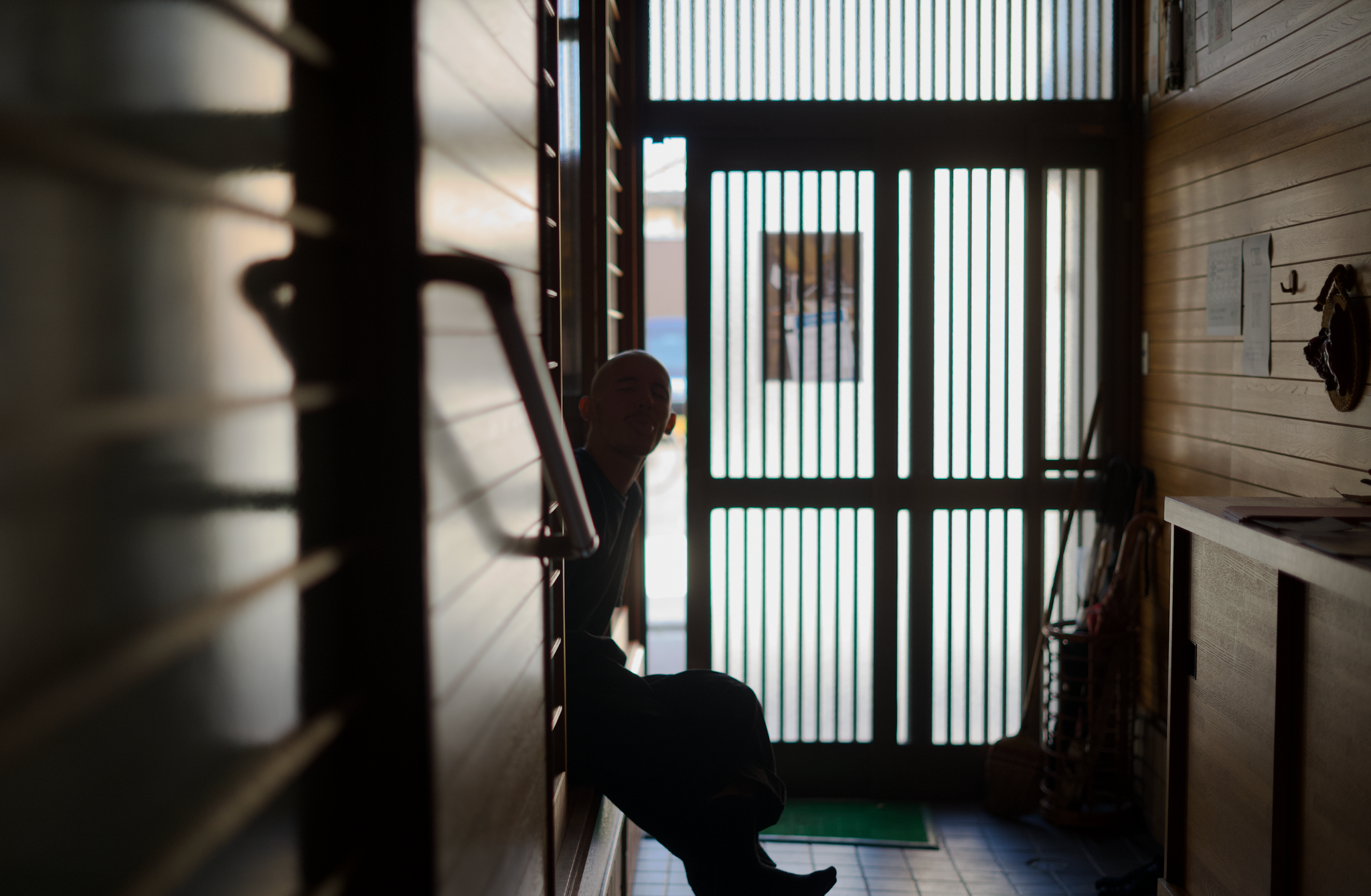
His work and activities here have exceeded my expectations. His lantern work has opened up this factory as a community space and an artistic place. I feel that it encompassed the identity of the community, the character of the fabric, the relationships I had, and even my family history, and made them visible as one space.
Paul
I had actually researched the neighborhoods and places in Kyoto online before I came here. But when I actually came here, met the people, walked with them, and talked with them, it was as if the ideas I had in my head began to open up to me.
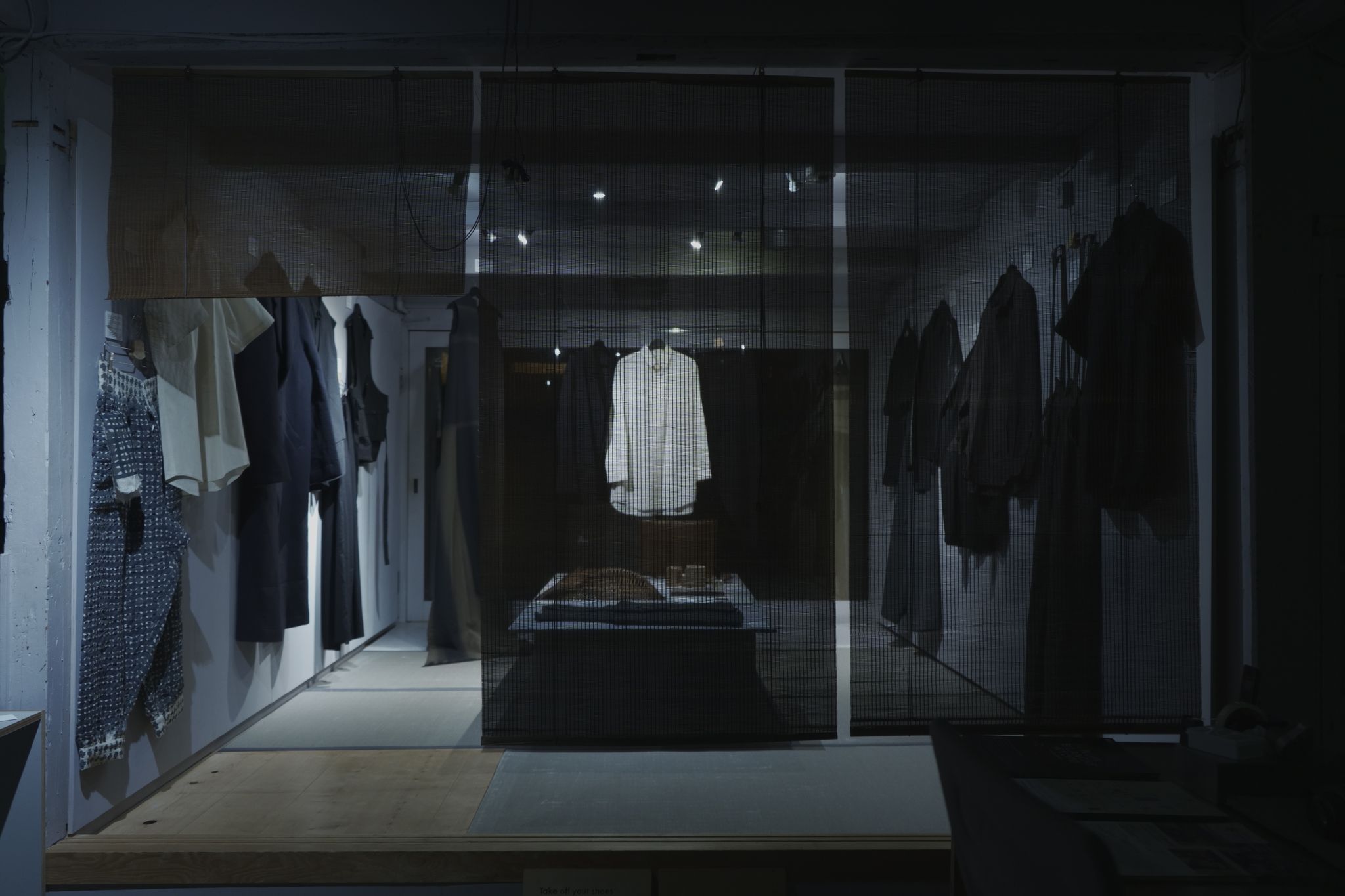
I dared to keep the lantern pieces simple in order to make the place and its surroundings stand up more. In fashion shows and collections, one strong piece can hide the others, but here I wanted people to feel the "place" itself, starting from the work. In that sense, I think the power of this factory was maximized.
Towa
It seems that not only the artworks, but also your "stay" itself created a lot of interaction.
Paul
Yes, it did. The accumulation of exchanges and dialogues made the work multi-layered. I think this is the difference between a product and a work of art.
A product needs to be a kind of "finished product," but with artwork, the opinions and impressions gained through the exhibition can become a part of it. This time, too, the various dialogues that took place at the venue became layers of the work as it was.
Towa
Do you consider your work as art? Or as a product?
Paul
I feel that my work leans more toward product. But that is also the very challenge I am grappling with.
In Japan, the boundary between product and art piece feels very thin. In the West, you are often required to define that boundary clearly. When I presented my collection at school, I was asked, “Are you making art, or are you making design?” But in Japan, I sense that viewers assign meaning for themselves.
Craftsmanship, too, is respected in Japan as a form of culture and value. In the West, it has declined in many places and is sometimes undervalued. That may be why my work, which questions the boundaries between craft, art, and design, feels more at home here.
When I presented my collection at MAGASINN KYOTO , some people saw the pieces as a statement, while others viewed them as everyday clothing. And that is perfectly fine. That very ambiguity generates discussion. This time, I was able to have many of those conversations in person.
It is rare and precious to have opportunities to speak about the background of my work in my own words and engage in dialogue. Here, I must have spoken about the work from at least thirty different perspectives. Each time, different questions and interpretations emerged, and that was exactly what I was hoping for.
“Do you think this is a product? Is it art? Or is it both?”
“Does it evoke any personal memories for you?”
By posing these questions to visitors, the work continued to evolve through dialogue. Even people who did not initially seem very interested in the exhibition stayed for at least twenty minutes and left with some words to share. That time was truly irreplaceable.
Masahiko
Everyone stayed for a long time and ended up in deep conversation with you. Questions kept emerging—“Why windows?” “Why lanterns?” It was an incredibly rich experience.
Towa
So many dialogues were generated. Did that experience change the way you approach your creative practice?
Paul
Yes, it did. I arrived here with a more design-oriented approach, but by the end of the residency, I had developed many new ideas that moved slightly away from fashion. I even felt as though I had rediscovered what I loved before I began working in fashion.
A residency gives you time to think carefully about your work without being pressured solely by outcomes. One month is not a particularly long time, but it was enough to experiment with different methods and directions, and to reexamine my core axis.
Towa
You also spent time in Tokyo. Did the specific character of Kyoto influence that shift?
Paul
Very much so. The new discoveries, the encounters with people, and the long conversations with Masahiko, these were things I could not have experienced in Tokyo.
In Kyoto, there is a calm flow of time that allows you to sit with your work and discuss it deeply with others. In Tokyo, it is easy to become consumed by daily routines. In Kyoto, there was space to pause.
Towa
Did your relationship with Masahiko also influence the works?
Paul
Of course. He is like a node that connects this place and its people. He brought many questions to me. By trying to form my own answers to those questions, I felt the work gained depth. When you create a piece that carries many questions within it, viewers are also invited to search for their own answers. The environment here was truly dialogical. It continuously generated new inquiries.
Towa
Masahiko, did this experience also affect your own creative practice, particularly as a musician?
Masahiko
Definitely. I consider myself fairly accustomed to communicating with artists, but Paul’s residency was still a major source of inspiration.
What struck me most was his approach to the exhibition. Some artists fill a space with information and layers of explanation, sometimes hiding something in the process. But Paul focused on a single piece, and by doing so, he drew out an abundance of voices and ideas.
I have always believed that a good artwork generates many voices and questions within the viewer. Seeing that realized through such a simple structure made me, honestly, a little jealous (laughs).
Towa
It truly feels as though a strong relationship and a cycle of inspiration emerged between the two of you.
Paul
Yes. What I appreciated most was that we were able to talk at length not only about work, but also about daily life and the neighborhood. Even those casual conversations gave rise to many ideas.
YC Notes | Towa
I was struck by the beautiful relationship between Paul and Masahiko. It was clear that they went beyond the roles of residence owner and creator; they respected each other as artists, but also connected as friends.
Embracing “change” - Energy Born from Different Perspectives
Masahiko
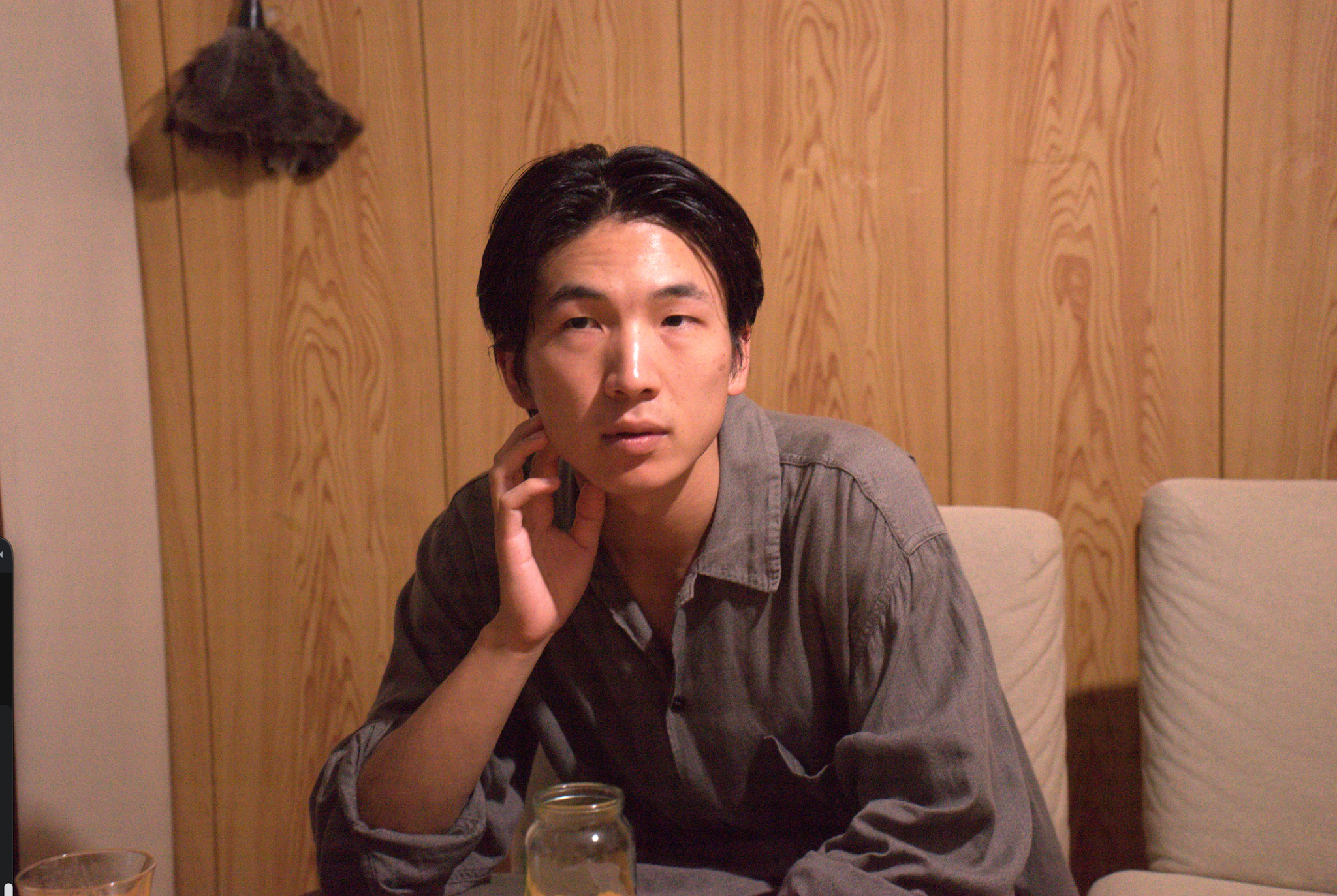
I came to feel that welcoming a creator from overseas and building a new relationship is, in itself, an act of embracing change. Looking back, perhaps my own transformation began the very moment I decided to welcome Paul.
Paul
At some point, you make a decision to accept something new. I think that single moment is what truly matters. Right now, in many places around the world, there is an atmosphere of fear toward change. But when someone comes from outside a community, things begin to mix, and new transformations emerge.
The history of Nishijin itself reflects this. Two hundred years ago, people from Nishijin traveled to France, learned new weaving and mechanical techniques, and brought them back to Kyoto. That exchange became the foundation of the traditional industry that continues today. Change from the outside is already inscribed in the history of this place.
Masahiko
In many conventional residency programs, a creator comes, focuses on their own production, and stays in exchange for that work. But this program is designed to function within relationships with the local community. Becoming part of the region is a fundamental premise.
Paul
That is exactly why I wanted to come here. The concepts and information presented on the website felt deeply coherent and meaningful. For someone considering relocating to Japan, I cannot imagine a better program.
Through this residency, I gained enough human connections to genuinely imagine staying here. If I do end up living in Japan one day, this program will undoubtedly be the reason. It was here that I discovered Kyoto, and fell in love with the city.
Masahiko
For Kyoto and for this project, that is the greatest gift we could hope for.
The Best Moment of the Creator and the Residence Owner!
Towa
Within this program, could you share the “best moment” that has stayed with you?
Paul
The first would be the factory visit to the Nishijin Weaving company “Obiyasutematsu”. When I found a book written in French inside the factory, I felt as though I was seeing physical proof that the connection between Kyoto’s Nishijin district and France truly exists.
Two hundred years ago, people from Nishijin traveled to France, learned new techniques, and brought them back to Kyoto. In that moment, I felt that history was directly connected to my own stay here—as if it were part of the same ongoing story.
It’s difficult to narrow it down to just one moment, but the countless encounters and conversations were all beautiful. Spending time exchanging ideas without judgment, genuinely trying to understand one another, felt incredibly warm and precious.
Towa
How about you, Masahiko?
Masahiko
It’s hard to choose just one, but I would say the Tango chirimen factory visit. I had visited once before, five years ago, as part of a research program in Kyoto. At the time, there was so much information that I couldn’t fully digest it.
From there, we began discussing with the factory team how we might create something together. When we witnessed the fabric shrink perfectly, I felt certain that something new was being born. Exchanging knowledge and ideas with the factory owner, and seeing each other’s eyes light up—that was truly a beautiful moment.
At that time, I felt genuinely proud to be both an artist and a residence owner.
Paul
That moment was definitely one of my best moments as well! If the techniques and methods we newly discovered could also open a new door for the people at the factory, that would make me incredibly happy.
17:00 Farewell Party at CORNER MIX “Farewell Is Not the End, but the Beginning of a Relationship” — The Open Space a Residence Leaves for What Comes Next
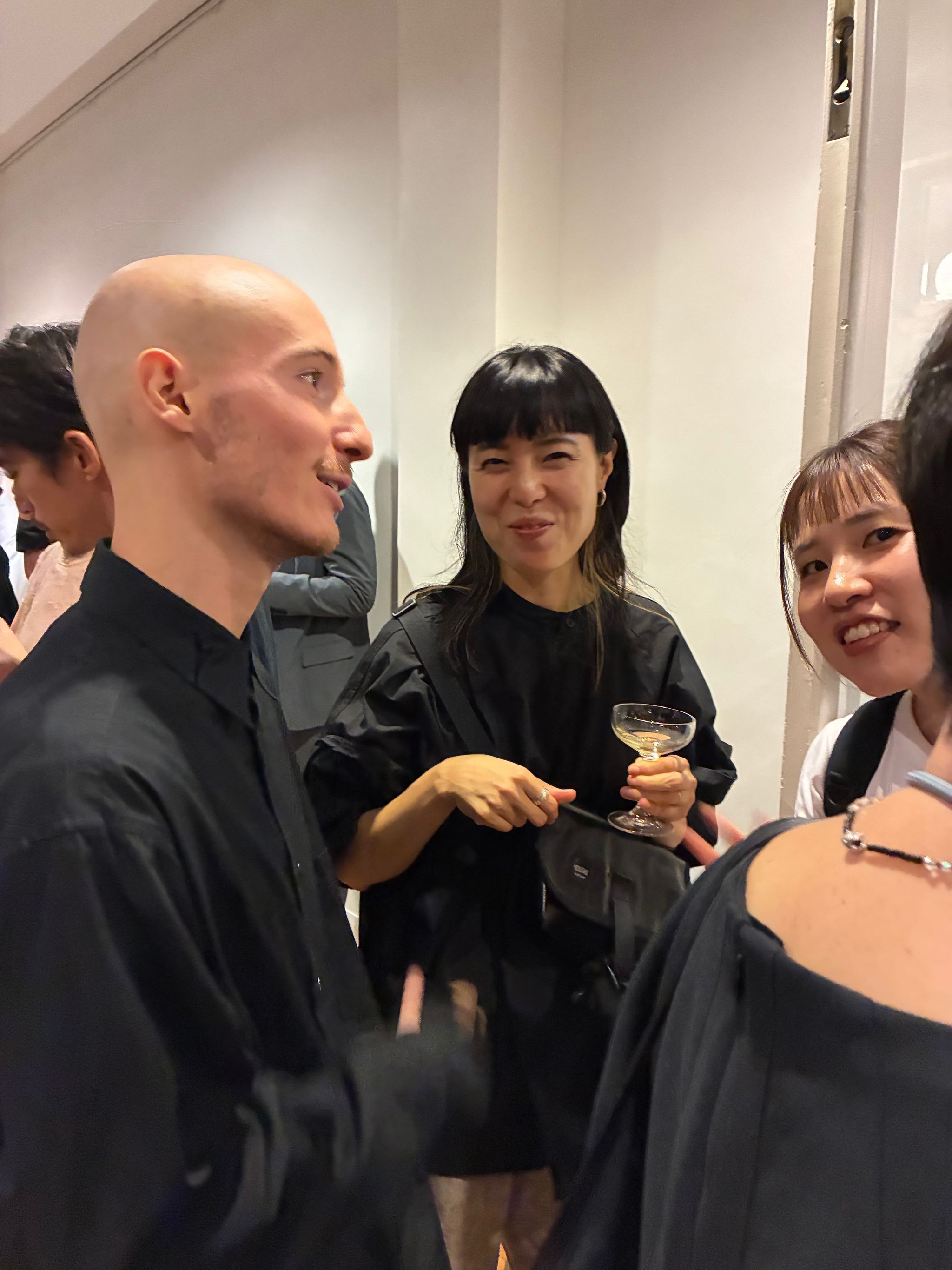
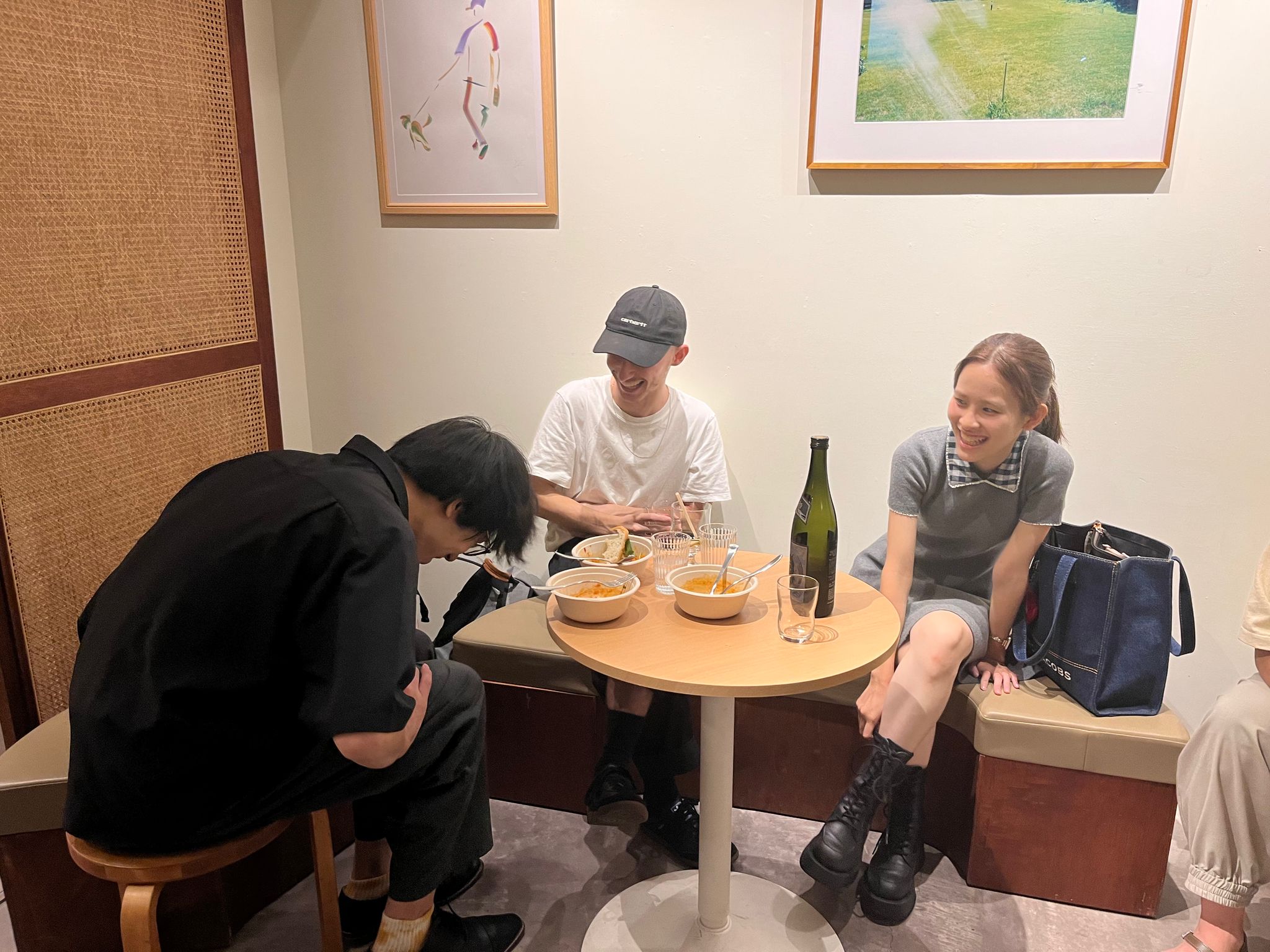
On Paul’s final day of his stay, a Farewell Party was held at “CORNER MIX,” a café affiliated with MAGASINN KYOTO, where he had been staying.We spoke candidly with Masahiko Takeda, both the residence owner and an active creator. And YC Kazuki, who aspires to pursue a career as an artist, about their perspectives on creativity and the way they choose to live.
YC Notes | Kazuki
Creating from “I Don’t Like It” or “I’m Not Good at It”
At first glance, Takeda seems like someone who creates spaces centered around music and communication. But his starting point was neither “because I love it” nor “because I’m good at it.”
He began music simply because a friend invited him.
As for communication, he actually felt he wasn’t good at it.
Precisely because of that, he read books, kept thinking, and tried to put into words questions like: Why doesn’t this get across? and How can I make it reach someone?
I used to think that feelings like “I don’t like it” or “I’m not good at it” were negative.
But sometimes, it’s exactly because there is distance that you can face something calmly. Even without a clear reason, even without natural talent, it’s okay to keep going. There are forms of expression that can only be born from that position.
The final words that remained were incredibly simple:
Just keep going. That’s enough.
Whether you like it or whether it suits you can change along the way. But if you continue, even your doubts and weaknesses will eventually become part of your expression.
For me, just beginning to walk the path of becoming an artist, these words became a quiet and steady source of support.
In Closing — Not a Farewell, but the Beginning of a Dialogue
Paul
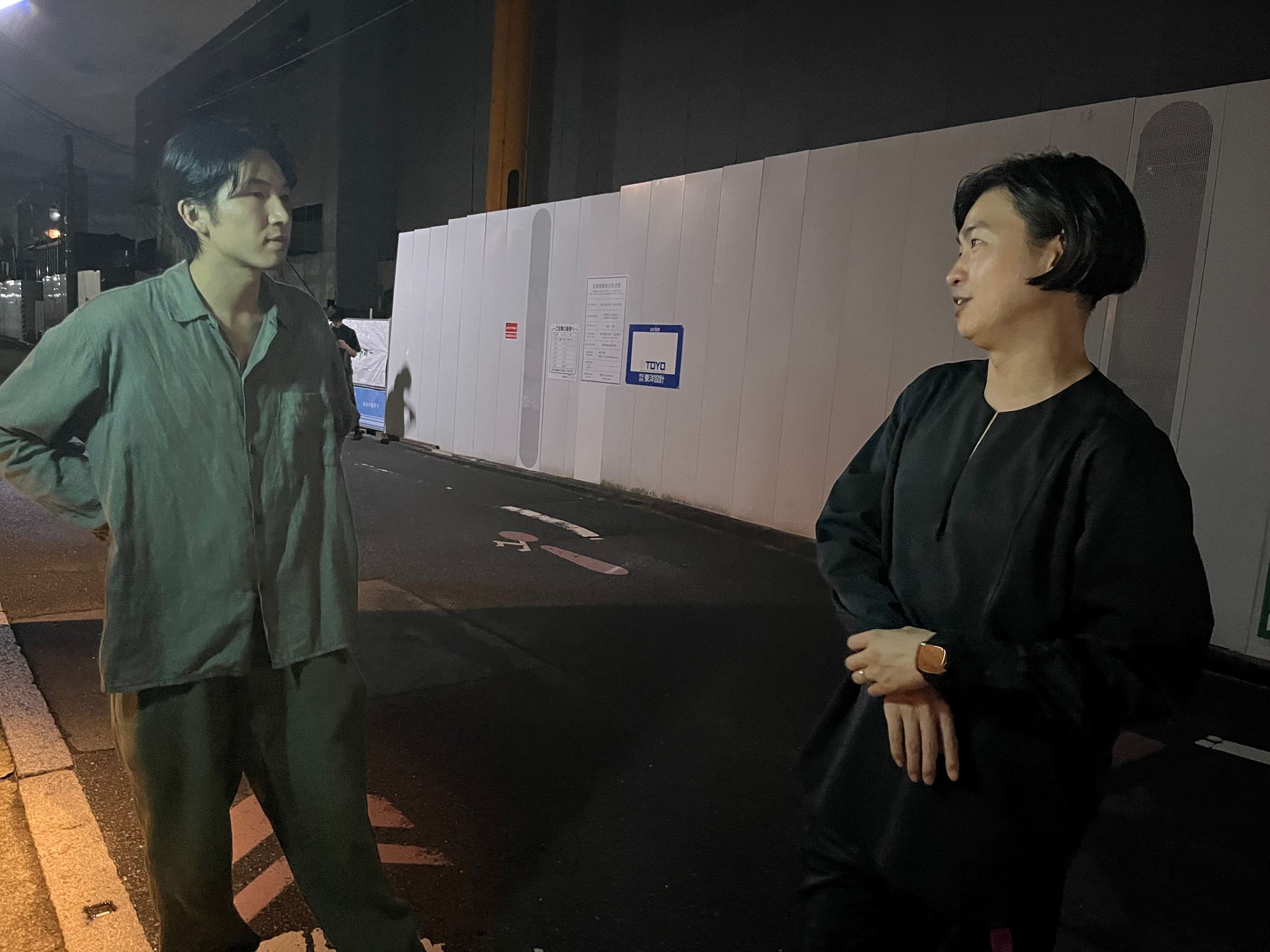
Thank you so much for welcoming me this time. Both MAGASINN KYOTO and CORNER MIX provided the best possible environment I could have asked for during my stay. It was truly a happy month from the bottom of my heart.
Masahiko
I’m really glad to hear you say that. It still doesn’t quite feel real that you’re leaving… But rather than a goodbye, it feels more like the beginning of a relationship that will continue from here. I’m looking forward to the day, hopefully in the near future, when we can create something together again in Kyoto.
Paul
Of course. I’ll be back very soon!
The end of the residency period is not an ending, but the beginning of a relationship.
The dialogues and encounters that were born here will continue, changing form as they move forward.
With a quiet but certain sense of anticipation, the natural feeling that one day we will return to Kyoto and see new works and new relationships emerge — I would like to close this record on that hopeful note.